There are passages in the Bible that seem almost mysterious when we first encounter them.
Genesis 15 is one of them.
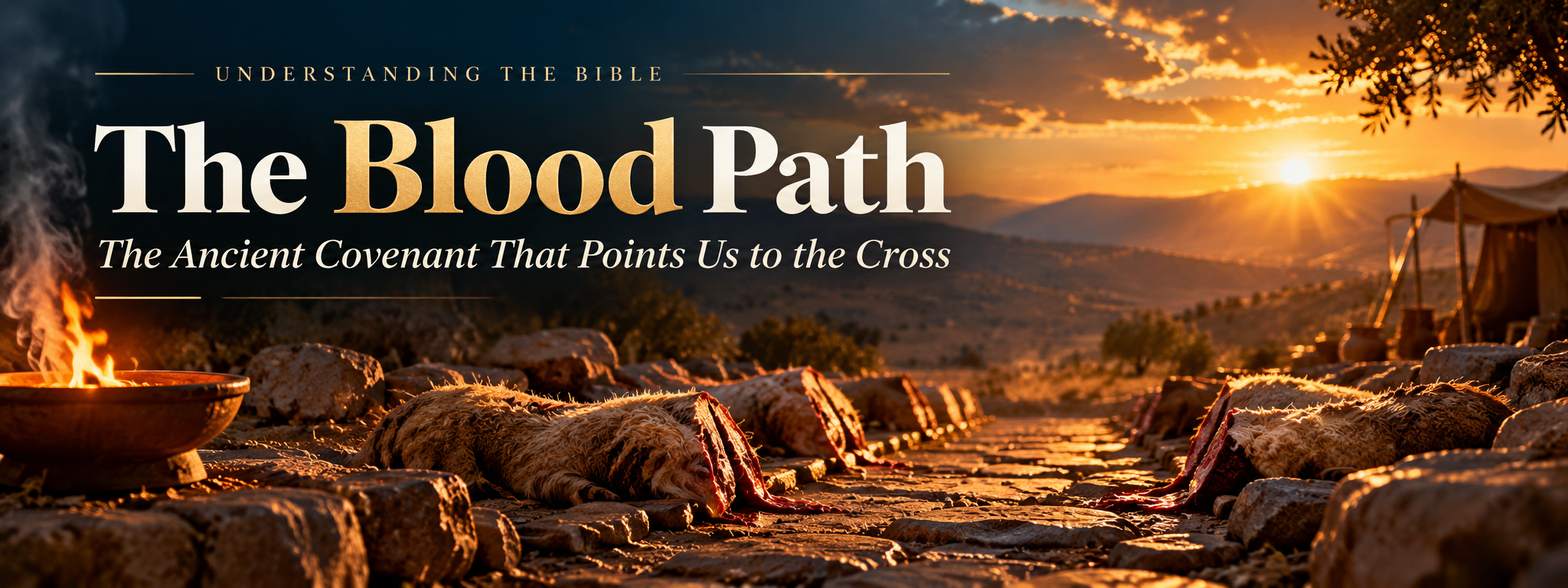
Animals cut in half.
A path between the pieces.
A deep sleep.
A terrifying darkness.
A smoking firepot.
A blazing torch.
And God passing between the pieces while Abraham sleeps.
What are we supposed to do with that?
At first glance, it can seem like one of those strange Old Testament passages we read quickly and move past.
But don't move past it.
Because hidden inside this ancient covenant ceremony is one of the most remarkable pictures of God's faithfulness in all of Scripture.
And once you understand what is happening...
you may never see the cross the same way again.
The Bible Is One Story
One of the greatest mistakes we can make when reading the Bible is treating it like a collection of disconnected stories.
Adam and Eve over here.
Abraham somewhere else.
Moses later.
David after that.
Jesus in the New Testament.
Revelation at the end.
But Scripture doesn't work that way.
The Bible is one unfolding story of creation, fall, redemption, and restoration.
And Jesus stands at the center of it.
The opening chapters of Genesis introduce a problem that the rest of Scripture will answer.
Humanity was created for relationship with God.
Then sin entered the story.
Adam and Eve rebelled against God, and everything changed.
Sin brought death.
Shame.
Separation.
The creation itself was subjected to the consequences of humanity's rebellion.
But something else happened almost immediately.
God made a promise.
The Promise in the Garden
In Genesis 3:15, God speaks to the serpent:
“I will put enmity
between you and the woman,
and between your offspring and hers;
he will crush your head,
and you will strike his heel.”
Christians have long called this the protoevangelium—the first announcement of the gospel.
Humanity has barely fallen...
and God is already pointing toward redemption.
Someone is coming.
The serpent will wound Him.
But He will crush the serpent.
The rescue plan begins almost as soon as the rebellion does.
Then Genesis tells us something else.
Adam and Eve had attempted to cover their shame with fig leaves.
But Genesis 3:21 says:
“The LORD God made garments of skin for Adam and his wife and clothed them.”
Genesis doesn't tell us precisely how God obtained those skins or describe this as an atoning sacrifice.
So we shouldn't make the text say more than it says.
But it does tell us something important.
Humanity's attempt to cover its own shame was replaced by a covering God Himself provided.
That pattern will appear again and again throughout Scripture.
Humanity cannot fix what sin has broken.
God must provide the covering.
And eventually...
God will provide much more than a covering.
The Last Adam
Centuries later, Paul gives us an extraordinary way of understanding Jesus.
He calls Him:
“the last Adam.”
— 1 Corinthians 15:45
Why Adam?
Because Jesus didn't simply come to improve humanity.
He came to accomplish what humanity had failed to accomplish.
Adam brought death.
Jesus brings life.
Adam failed in a perfect garden.
Jesus remained faithful in a world broken by sin.
Adam hid from God in shame.
Jesus opened the way back to God.
Adam's disobedience brought condemnation.
Jesus' obedience brings righteousness.
Paul puts it this way:
“For just as through the disobedience of the one man the many were made sinners, so also through the obedience of the one man the many will be made righteous.”
— Romans 5:19
Everything Scripture has been building toward finds its answer in Jesus.
But between Adam and Jesus stands a man named Abraham.
And a covenant made in the darkness.
Abraham Asked a Question
God had promised Abraham something enormous.
Descendants.
Land.
A future.
And ultimately, through Abraham's family, blessing for the nations.
But Abraham had a problem.
He couldn't see how it was going to happen.
So in Genesis 15:8 he asks:
“Sovereign LORD, how can I know...?”
I love that question.
Abraham believes God.
But he still asks:
How can I know?
And God doesn't rebuke him.
Instead, God gives Abraham a sign he would understand.
He tells him to bring several animals.
Abraham prepares them.
He cuts some of them in two.
He arranges the pieces opposite one another.
And suddenly this strange scene begins to make sense when we understand the world in which Abraham lived.
The Blood Path
In the ancient Near East, covenants could be accompanied by solemn oath ceremonies involving slaughtered animals.
The imagery communicated something deadly serious:
Breaking this covenant deserves judgment.
Jeremiah 34 gives us another biblical glimpse of this kind of ceremony. People who had violated a covenant are described as having “cut the calf in two and walked between its pieces.”
The imagery is unmistakable.
A covenant wasn't a casual promise.
It was a binding oath.
And now Abraham has prepared such a path.
The pieces are laid out.
Abraham waits.
The sun begins to set.
And then something unexpected happens.
“Abram fell into a deep sleep, and a thick and dreadful darkness came over him.”
— Genesis 15:12
Abraham isn't standing beside God preparing to walk the path.
Abraham is asleep.
Then:
“When the sun had set and darkness had fallen, a smoking firepot with a blazing torch appeared and passed between the pieces.”
— Genesis 15:17
Something representing God's presence passes between the pieces.
But Abraham doesn't.
God passes through the covenant path alone. Revelation Revealed (7)
Don't miss the significance.
God had made promises to Abraham.
And now God symbolically binds Himself to His word.
Abraham's confidence will not ultimately rest upon Abraham's ability to make God's promise happen.
It rests upon the faithfulness of the God who made the promise.
That changes everything.
God Walked the Path
Think about what Abraham had asked:
How can I know?
God's answer wasn't merely another sentence.
God entered the covenant ceremony.
It was as though He were saying:
You can know because I have bound Myself to My promise.
That is one of the great themes running through Scripture.
God is faithful...
even when His people are not.
Israel would fail repeatedly.
Abraham's descendants would rebel.
Kings would turn away.
The nation would experience judgment and exile.
Humanity would continue doing what humanity had done since Eden.
And yet God's redemptive purpose continued moving forward.
Why?
Because the story ultimately depends upon God's faithfulness, not ours.
And that brings us to Jesus.
From the Blood Path to the Cross
Thousands of years after Abraham stood beside those pieces...
another darkness fell.
Jesus hung on a Roman cross.
Matthew tells us:
“From noon until three in the afternoon darkness came over all the land.”
— Matthew 27:45
We should be careful here.
Matthew never explicitly says, “This darkness fulfills Genesis 15.”
So I wouldn't claim that Scripture makes that direct identification.
But once you have read Genesis 15, the echo is difficult to miss.
Darkness.
Covenant.
Judgment.
Blood.
And once again, God is doing what humanity cannot do for itself.
At the cross, Jesus bears the curse of sin.
Paul writes:
“Christ redeemed us from the curse of the law by becoming a curse for us.”
— Galatians 3:13
The God who bound Himself to His promises...
kept them at immeasurable cost to Himself.
This is why the cross was never God's emergency response to an unexpected problem.
The cross was not God's backup plan.
It was the plan from the beginning.
He Became One of Us
There is another biblical idea that helps us understand what Jesus did.
The Old Testament introduces the concept of a kinsman-redeemer.
When something had been lost within a family, a qualified relative could sometimes step in to redeem what had been forfeited.
The book of Ruth gives us the most familiar picture.
Boaz could act because he was a kinsman.
He was willing.
And he had the ability to redeem.
Now look at Jesus.
John tells us:
“The Word became flesh and made his dwelling among us.”
— John 1:14
The eternal Son became human.
He became one of us.
Hebrews says:
“Since the children have flesh and blood, he too shared in their humanity...”
— Hebrews 2:14
And Jesus says of His life:
“No one takes it from me, but I lay it down of my own accord.”
— John 10:18
He was able.
He was willing.
And He became one of us.
Jesus came to redeem what sin had taken.
“It Is Finished”
Then comes one of the most powerful moments in the Gospels.
Jesus is hanging on the cross.
His work is complete.
And John records His final declaration:
“It is finished.”
— John 19:30
The Greek word is tetelestai.
It means finished, completed, accomplished.
And I actually want us to stop there.
You may have heard that tetelestai was routinely stamped on ancient bills to mean “paid in full.” That illustration is frequently repeated in Christian teaching.
But we don't need it.
John's words are powerful enough.
Jesus finished the work the Father had given Him to do.
The plan that runs through Scripture...
The promises.
The covenants.
The sacrifices.
The shadows.
The anticipation.
The Lamb.
The cross.
Accomplished.
Jesus didn't say:
“I am finished.”
He said:
“It is finished.”
There is an enormous difference.
This Is How the Bible Fits Together
Now step back.
Look at what we've just traveled through.
Genesis 3.
Genesis 15.
The covenant.
The sacrifices.
The Kinsman-Redeemer.
The Last Adam.
The cross.
And we're still not finished.
Because the story keeps moving.
All the way to Revelation.
That's why learning to see the connections in Scripture matters.
You can read Genesis 15 as an isolated story about Abraham.
And you can learn something from it.
But when you see Genesis 15 as one part of the Bible's unfolding story...
the passage comes alive.
The Bible begins to feel less like dozens of disconnected books...
and more like what it actually is:
one story.
The Lamb Who Was Slain
In Revelation 5, John sees a scroll in the right hand of the One seated upon the throne.
But no one is found worthy to open it.
John begins to weep.
Then an elder tells him:
“Do not weep! See, the Lion of the tribe of Judah, the Root of David, has triumphed.”
— Revelation 5:5
John turns expecting a Lion.
But what does he see?
“Then I saw a Lamb, looking as if it had been slain...”
— Revelation 5:6
The Lion has conquered...
as the Lamb.
The One who stands victorious is the One who shed His blood.
The cross isn't something Jesus leaves behind when we reach Revelation.
The cross is part of why He is worthy.
And heaven sings:
“You are worthy to take the scroll
and to open its seals,
because you were slain,
and with your blood you purchased for God
persons from every tribe and language and people and nation.”
— Revelation 5:9
There it is again.
Blood.
Redemption.
Promise.
Fulfillment.
The story that began in Genesis has reached the throne room of Revelation.
And the Story Ends Where It Began
Then something extraordinary happens in the final two chapters of the Bible.
Things we lost in Genesis begin appearing again.
The Tree of Life.
The river.
The presence of God.
Humanity dwelling with its Creator.
Revelation 22 says:
“No longer will there be any curse.”
— Revelation 22:3
Think about those words.
No more curse.
The curse introduced in Genesis is gone.
Revelation isn't God suddenly changing the subject.
It's God finishing the story.
Genesis tells us what was lost.
The Gospels show us the One who came to redeem it.
Revelation shows us what happens when redemption is finally complete.
The story comes full circle.
What the Blood Path Means for You
All of this theology eventually becomes personal.
Because Abraham's question is our question too.
How can I know?
How can I know God will keep His promises?
How can I know grace is enough?
How can I know that my failures haven't somehow surprised Him?
How can I know that God will finish what He started?
Look at the blood path.
Look at the cross.
Look at the empty tomb.
Look at the Lamb standing in Revelation.
Our confidence isn't rooted in our ability to hold tightly enough to God.
It is rooted in the character of the God who holds us.
God kept His promise to Abraham.
He kept His promise through Israel.
He kept His promise at the cross.
And Scripture tells us He will keep His promises all the way to the end.
That's why understanding the Bible as one story matters.
Because when you begin seeing the connections...
you begin seeing something even greater.
You begin seeing the faithfulness of God everywhere.
And ultimately...
you begin seeing Jesus.
Keep Following the Story
This teaching was adapted from my forthcoming book, Revelation Revealed: Seeing Jesus in the End Times.
It may seem surprising that a book about Revelation spends so much time in Genesis.
But that's exactly the point.
You cannot fully appreciate the ending until you understand the beginning.
Revelation Revealed follows these threads throughout Scripture—showing how the Bible's final book completes a story God has been telling from the very beginning.
Revelation Revealed: Seeing Jesus in the End Times
Coming Soon