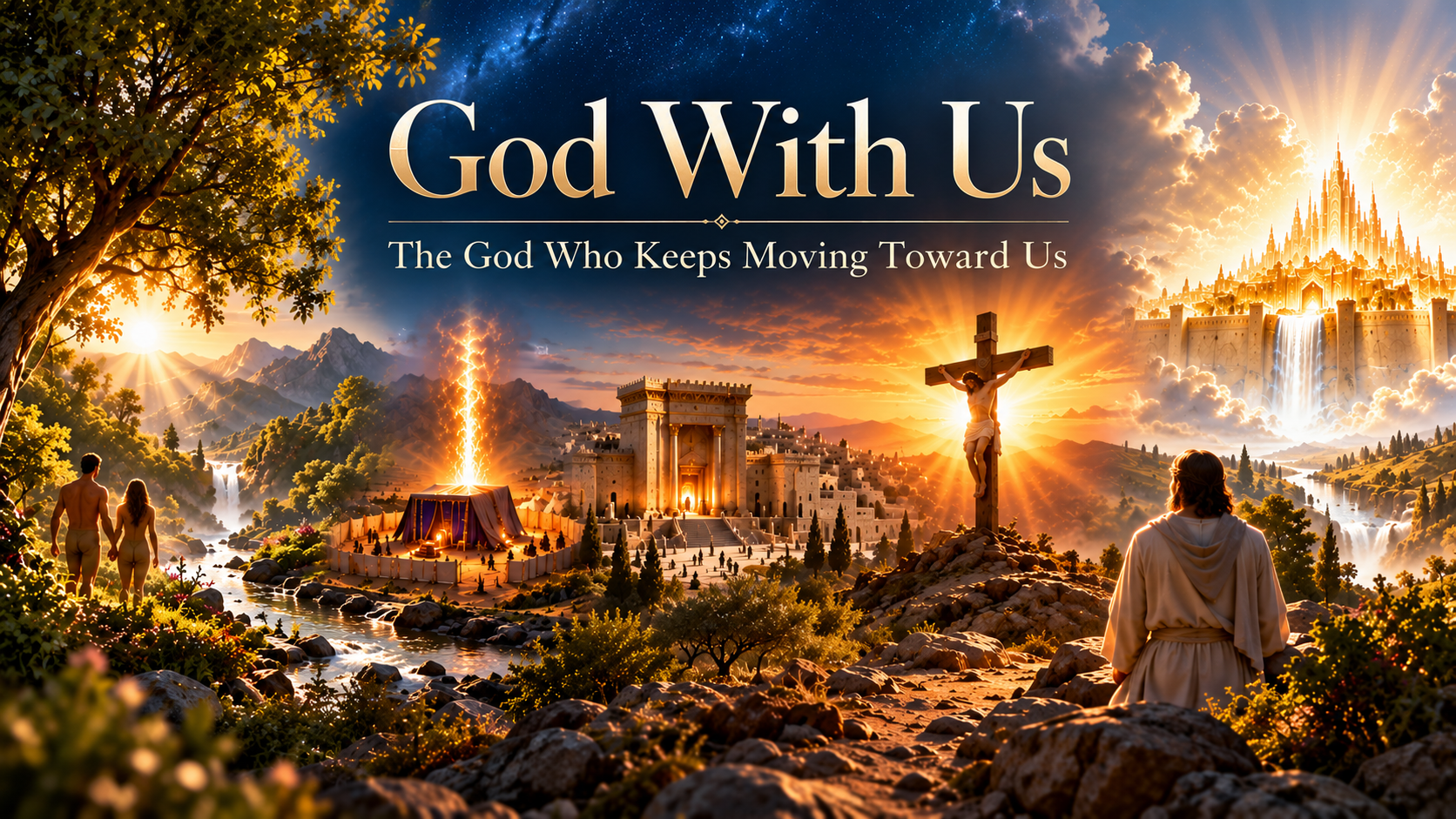
God With Us
The God Who Keeps Moving Toward Us
There is a way we often tell the story of faith.
Humanity is down here.
God is somewhere up there.
And our job is to somehow find our way back to Him.
Be good enough.
Pray enough.
Learn enough.
Clean ourselves up enough.
Climb high enough.
And perhaps, if we do enough of the right things, we can finally reach God.
But that isn't the story the Bible tells.
In fact, when you step back and look at Scripture from beginning to end, something remarkable begins to emerge.
Again and again, God is the One moving toward us.
When humanity hides, God comes looking.
When sin creates distance, God begins closing it.
When His people wander through the wilderness, God puts His dwelling in the middle of their camp.
Eventually, He does something almost unimaginable.
He becomes one of us.
And even that isn't as close as He intends to come.
From the Garden of Eden to the New Jerusalem, the Bible tells the story of a God who refuses to remain far away.
This is the story of God with us.
In the Beginning, There Was No Distance
To understand the story, we have to go all the way back to the beginning.
Before there was a tabernacle.
Before there was a temple.
Before there was a Bible.
Before there was even sin.
There was a garden.
Genesis tells us that God created Adam and Eve and placed them in Eden.
And there was something about their existence that is difficult for us to even imagine.
There was no distance between humanity and God.
Genesis 3 describes God walking in the garden.
No temple was necessary.
No priest stood between God and humanity.
No sacrifice had to be offered.
No curtain separated the holy from the unholy.
No one was hiding.
God was with His people.
And His people were with Him.
This was how creation was supposed to be.
But then sin entered the story.
Adam and Eve rebelled against God.
Suddenly there was shame.
Fear.
Hiding.
And separation.
They were driven from Eden, and cherubim guarded the way back.
Something had been lost.
Humanity still bore the image of God.
God still loved the people He had created.
But sin had created a separation between a holy God and fallen humanity.
And if the Bible ended in Genesis 3, ours would be an unbearably tragic story.
But it doesn't.
Because almost immediately, God begins moving toward us again.
God Moves Into the Neighborhood
Centuries pass.
God rescues the Israelites from slavery in Egypt and brings them into the wilderness.
And there He gives Moses an unusual command.
Build Me a tent.
We call it the Tabernacle.
But why would the Creator of the universe need a tent?
God Himself gives the answer:
“Then have them make a sanctuary for me, and I will dwell among them.”
— Exodus 25:8
Don't move past that too quickly.
God had just delivered a nation of former slaves from Egypt.
He could have ruled them from a distance.
He could have remained on the mountain.
Instead, He said:
I want to dwell among them.
And look at where God told Israel to put the Tabernacle.
At the center of the camp.
The tribes surrounded it.
God placed His dwelling right in the middle of the dirt, noise, families, animals, arguments, meals, children and mess of everyday life.
The God of the universe moved into the neighborhood.
His presence was real.
His glory filled the Tabernacle.
God was moving closer.
But something was still wrong.
There were curtains.
There were priests.
There were sacrifices.
At the center of the Tabernacle was the Most Holy Place, and access to God's presence was severely restricted.
God was among His people.
But the distance created by sin had not yet been completely removed.
The Tent Became a Temple
Eventually Israel settled in the Promised Land.
The portable tent was replaced by a magnificent Temple in Jerusalem.
When Solomon dedicated it, the glory of God filled the Temple so powerfully that the priests could not perform their service.
God was dwelling among His people.
But again, there was a barrier.
Deep inside the Temple was the Most Holy Place.
And separating it from everyone else was a curtain.
Only the high priest could pass beyond that curtain.
Only once a year.
And never without sacrificial blood.
Think about the message that curtain silently proclaimed year after year:
God is here.
But also:
Something still separates us.
The Temple was a tremendous gift.
But it wasn't the destination.
God wasn't finished closing the distance.
Then God Came in Person
And this is where John's Gospel says something breathtaking.
John begins by telling us that the eternal Word was with God and was God.
Through Him everything was made.
And then John writes:
“The Word became flesh and made his dwelling among us.”
— John 1:14
We've heard that verse so many times that it's easy to miss what John is saying.
The Word became flesh.
God didn't send another prophet.
He didn't simply speak from heaven.
He didn't send an angel with another message.
He came Himself.
Jesus got hungry.
He got thirsty.
He became tired.
He wept.
He could be touched.
He bled.
The infinite God stepped into His creation and became one of us.
But there is something else hidden inside John's words.
When John says Jesus “made his dwelling among us,” the language echoes the Tabernacle.
The Word became flesh and tabernacled among us.
Do you see the progression?
In the wilderness, God's presence dwelled in a tent.
Later, His glory filled a Temple.
And then...
God walked into the world in a human body.
The presence of God was no longer behind a curtain in Jerusalem.
He was walking dusty roads.
Sitting at tables.
Touching lepers.
Holding children.
Speaking with outcasts.
Weeping with grieving friends.
God had come closer.
Jesus was Emmanuel.
God with us.
Or to say it another way:
He pitched His tent in our dirt.
And Then the Curtain Tore
But there was still a problem.
Sin.
God had come to us, but the very thing that drove humanity from Eden still had to be dealt with.
And that's why Jesus went to the cross.
Matthew tells us that at the moment Jesus died, something extraordinary happened inside the Temple.
“At that moment the curtain of the temple was torn in two from top to bottom.”
— Matthew 27:51
The curtain.
The barrier.
The enormous symbol that had declared for generations that sinful humanity could not simply walk into the presence of a holy God.
It tore.
And notice the direction.
From top to bottom.
God was doing what humanity could never do for itself.
Through the sacrifice of Jesus, the barrier of sin was being dealt with.
The way into God's presence had been opened.
The God who had been moving toward humanity throughout the entire story had come all the way to the cross.
He came to get us.
But God Wasn't Finished Getting Closer
You might think that would be the end of the progression.
God walked with humanity in Eden.
Then He dwelled among Israel.
Then He came in the person of Jesus.
How could God possibly come any closer?
Jesus told His disciples.
Before He went to the cross, He explained that after He left, the Father would send the Holy Spirit.
And after the resurrection and ascension, that's exactly what happened.
At Pentecost, the Holy Spirit came.
But this time God's presence didn't descend into a tent.
It didn't fill a stone Temple.
He came to dwell in people.
Paul would later tell believers:
“Do you not know that your bodies are temples of the Holy Spirit, who is in you?”
— 1 Corinthians 6:19
Think about the movement.
The Garden.
The Tabernacle.
The Temple.
Jesus.
And now...
you.
God moved from dwelling among His people to dwelling within His people.
The God who once placed His presence in the center of Israel's camp now makes His home within those who belong to Christ.
That's how determined God is to close the distance.
And Still, God Isn't Finished
Even now, the story isn't complete.
We know God.
His Spirit dwells within us.
We experience His presence.
But we still live in a broken world.
We still experience sickness.
We still bury people we love.
We still battle sin.
We still have moments when God feels farther away than we wish He did.
Something more is coming.
And once again, to understand where the story is going, we have to go to Revelation.
John sees a new heaven and a new earth.
He sees the New Jerusalem coming down from heaven.
And then he hears a voice from the throne:
“Look! God’s dwelling place is now among the people, and he will dwell with them. They will be his people, and God himself will be with them and be their God.”
— Revelation 21:3
There it is again.
God with us.
The same desire we saw in Eden.
The same desire behind the Tabernacle.
The same desire behind the Temple.
The same desire revealed when the Word became flesh.
The same desire revealed when the Holy Spirit came to dwell within believers.
Now it reaches its complete fulfillment.
God Himself will be with us.
No curtain.
No priest standing between us.
No Temple separating one place as more holy than another.
In fact, John specifically tells us there is no temple in the New Jerusalem.
Why?
Because one isn't needed.
God is there.
The distance is gone.
The Story Ends Where It Began
And this may be one of the most beautiful things about the entire Bible.
The story ends where it began.
In Genesis, God is with His people.
In Revelation, God is with His people.
But everything that separated those two moments has finally been removed.
In Genesis, humanity is driven from God's presence.
In Revelation, we live in His presence forever.
The flaming sword is gone.
The curtain is gone.
The distance is gone.
The unhindered fellowship humanity lost in Eden has been restored.
Only this time, it can never be lost again.
And suddenly the Bible begins to look different.
It isn't primarily the story of humanity desperately trying to find God.
It's the story of God relentlessly moving toward humanity.
When we ran...
He came after us.
When sin separated us...
He began closing the distance.
When we could not climb our way to Him...
He came down to us.
The Creator refused to stay far away.
He moved into the camp.
He filled the Temple.
He became flesh.
He went to the cross.
He sent His Spirit.
And one day, He will make all things new and dwell with His people forever.
Maybe God Is Closer Than You Think
Perhaps you've spent much of your life believing that God is reluctant.
That He's standing at a distance waiting for you to get your life together.
That you need to become a better person before He wants anything to do with you.
But that isn't the God we meet in Scripture.
From the first pages of Genesis to the final pages of Revelation, we encounter a God who keeps moving toward broken people.
That doesn't mean sin doesn't matter.
It matters so much that Jesus went to the cross to deal with it.
But the cross reveals something else too.
Look how far God was willing to come.
He didn't wait for us to find our way back.
He came to us.
And the final destination of the Christian story isn't simply streets of gold.
It isn't mansions.
It isn't even escaping death.
The great promise of eternity is something far better:
“God himself will be with them.”
That's what we lost in Eden.
That's what Jesus came to restore.
And that's where the entire story of Scripture is going.
God with us.
No distance.
No curtain.
No separation.
Forever.
Want to Go Deeper?
This teaching is adapted from material I’m developing for my upcoming book, The Word Made Flesh: A Verse-by-Verse Study of the Gospel of John.
John begins his Gospel with one of the most extraordinary truths in all of Scripture: “The Word became flesh and made his dwelling among us.”
The book will take a deeper look at who Jesus is, why He came, and what His life, words, signs, death, and resurrection reveal about the heart of God.
The Word Made Flesh — Coming Late 2027