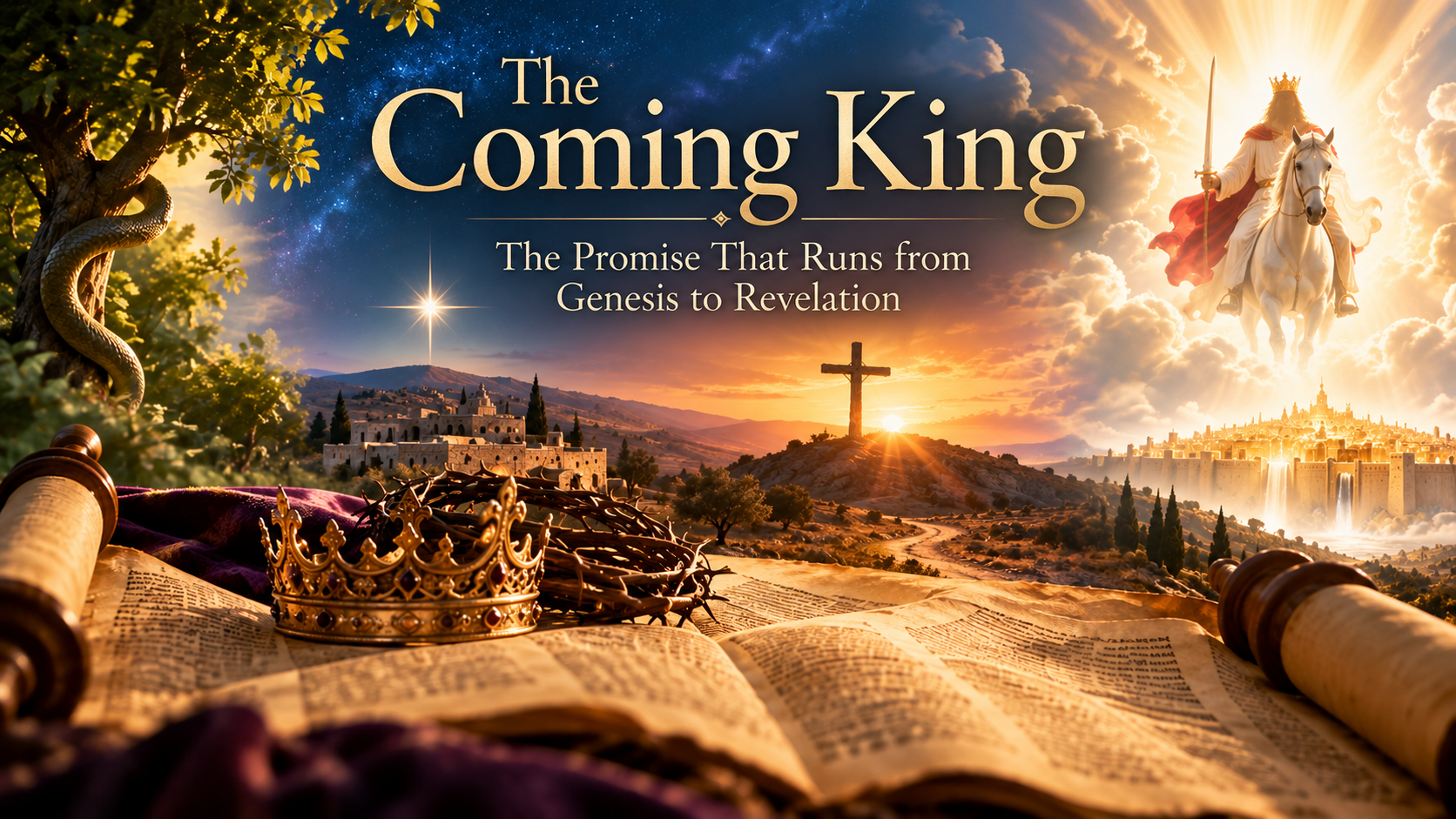
The Coming King
The Promise That Runs from Genesis to Revelation
Long before there was a manger in Bethlehem, there was a promise.
Long before the shepherds heard the angels sing...
Long before the wise men followed the star...
Long before Isaiah spoke of a child who would be born or Micah named the little town where He would enter the world...
God said Someone was coming.
The story begins in Genesis almost as soon as sin enters the world.
And it doesn't end until the final pages of Revelation.
From Genesis to Revelation, the Bible tells one unfolding story of a promised King.
A King who would come.
A King who would suffer.
A King who would conquer death.
And a King who is coming again.
Because Bible prophecy isn't ultimately the story of what is coming.
It's the story of Who is coming.
The First Promise
The setting could hardly be darker.
God had created a world that was good.
Humanity enjoyed fellowship with Him.
There was no death.
No shame.
No separation.
And then came Genesis 3.
The serpent deceived Eve. Adam and Eve rebelled against God. Sin entered the world, and everything changed.
But notice what God did next.
Before Adam and Eve ever left the garden, God gave humanity its first glimpse of hope.
Speaking to the serpent, God said:
“And I will put enmity
between you and the woman,
and between your offspring and hers;
he will crush your head,
and you will strike his heel.”— Genesis 3:15
Christians have historically called this verse the protoevangelium—the first announcement of the gospel.
The promise is still veiled. Genesis doesn't give us a name. It doesn't tell us when He will come.
But we are given our first glimpse.
Someone is coming.
The serpent will wound Him.
But He will ultimately crush the serpent.
And from that moment forward, the rest of Scripture begins answering the question:
Who is He?
The Promise Becomes a King
As the story of Scripture unfolds, the picture becomes clearer.
God calls Abraham and promises that through his offspring all nations of the earth will be blessed.
Later, God makes a covenant with David.
David was a shepherd who became Israel's greatest king. But God promised that David's story would lead to another King.
A descendant would come whose kingdom would endure.
Then, centuries before Jesus was born, the prophet Isaiah gave us an extraordinary picture:
“For to us a child is born,
to us a son is given,
and the government will be on his shoulders...Of the greatness of his government and peace
there will be no end.He will reign on David's throne
and over his kingdom...
from that time on and forever.”— Isaiah 9:6–7
Now the promise is becoming clearer.
The One who is coming will be a King.
And His kingdom will never end.
Centuries later, an angel named Gabriel appeared to a young woman named Mary.
Listen to what he told her about the child she would bear:
“The Lord God will give him the throne of his father David, and he will reign over Jacob's descendants forever; his kingdom will never end.”
— Luke 1:32–33
Do you see it?
God hadn't forgotten the promise.
The King was coming.
The King Had an Address
Then God gave another remarkable detail.
Hundreds of years before Jesus was born, the prophet Micah wrote:
“But you, Bethlehem Ephrathah,
though you are small among the clans of Judah,
out of you will come for me
one who will be ruler over Israel...”— Micah 5:2
The promise now had a family line.
It had a throne.
And now...
it had an address.
Bethlehem.
Think about that.
God identified the town where the coming ruler would be born centuries before His birth.
And when the time finally came, Joseph and Mary traveled to Bethlehem.
There, in an insignificant little town, far from the palaces of earthly kings...
the King arrived.
Not surrounded by armies.
Not sitting upon a throne.
Not wearing a crown.
He came as a baby.
The Creator entered His creation.
The eternal Son stepped into time.
The promised King had come.
The King Rode Into Jerusalem
But the prophets weren't finished.
Hundreds of years before Jesus entered Jerusalem, Zechariah wrote:
“See, your king comes to you,
righteous and victorious,
lowly and riding on a donkey.”— Zechariah 9:9
Then came the day we call Palm Sunday.
Jesus approached Jerusalem.
Crowds gathered.
Branches were spread before Him.
People shouted:
“Hosanna!”
And Jesus rode into the city on a donkey.
The King had arrived exactly as Zechariah had described.
But something unexpected was happening.
Jesus wasn't riding toward a palace.
He wasn't riding toward an earthly throne.
He was riding toward a cross.
Israel had been waiting for a King who would conquer her enemies.
Jesus had come to conquer an enemy far greater than Rome.
Sin.
Death.
And the serpent who had been destroying God's creation since Genesis 3.
The King Would Be Pierced
The Old Testament had revealed this part of the story too.
Isaiah wrote of a Servant who would be despised and rejected.
He would be:
“pierced for our transgressions”
and
“crushed for our iniquities.”— Isaiah 53:5
Psalm 22 describes suffering in language that would echo through the crucifixion.
Zechariah speaks of people looking upon the one who was pierced.
The promised King would suffer.
And then came Calvary.
The hands that had healed the sick were nailed to a cross.
The One who had opened blind eyes was mocked.
The One through whom all things were created was rejected by His creation.
And the King was given a crown.
But it was made of thorns.
Before He wore the crown of the King,
He wore the crown of thorns.
For a moment, it must have looked as though the serpent had won.
Jesus was dead.
His body was placed in a tomb.
The stone was rolled into place.
But Genesis 3 had not promised that the serpent would win.
It promised that the serpent would strike His heel.
And that the serpent's head would be crushed.
The King Rose
Three days later, the tomb was empty.
Jesus rose from the dead.
The King the serpent had tried to destroy had conquered the very weapon the enemy had brought into God's creation.
Death.
This is why the resurrection is so much more than a miraculous ending to the story of Jesus.
It is victory.
Sin did not win.
Satan did not win.
Death did not win.
Jesus won.
But even the resurrection isn't the end of the story.
Because centuries before Jesus walked out of that tomb, Daniel had seen something else.
Daniel Saw the Coming King
About six hundred years before Jesus was born, the prophet Daniel received an extraordinary vision.
He wrote:
“There before me was one like a son of man, coming with the clouds of heaven...
He was given authority, glory and sovereign power; all nations and peoples of every language worshiped him.
His dominion is an everlasting dominion that will not pass away, and his kingdom is one that will never be destroyed.”
— Daniel 7:13–14
Daniel saw a King.
A King with authority over every nation.
A King worshiped by people everywhere.
A King whose kingdom would never end.
And centuries later, Jesus repeatedly used a particular title for Himself:
The Son of Man.
The man walking the dusty roads of Galilee was the One Daniel had seen.
But Daniel's vision pointed beyond Bethlehem.
Beyond Calvary.
Beyond even the empty tomb.
Daniel saw the King reigning.
Which means part of the promise was still waiting.
Then Heaven Opens
And that brings us to Revelation 19.
The Bible began with a world shattered by sin.
Now, near the end of the story, the earth is again in rebellion against God.
But then John sees something.
Heaven opens.
And Someone is coming.
“I saw heaven standing open and there before me was a white horse, whose rider is called Faithful and True.”
— Revelation 19:11
Stop there for a moment.
Faithful and True.
Those words matter.
The One who is coming is the same One God has been promising since Genesis.
Every promise.
Every prophecy.
Every covenant.
Every page has been moving toward Him.
John continues:
“He is dressed in a robe dipped in blood, and his name is the Word of God.”
— Revelation 19:13
The Word.
The same Word John introduced at the beginning of his Gospel:
“In the beginning was the Word.”
The One who was there at creation.
The One who became flesh.
The One who died.
The One who rose.
The Word is coming again.
And then John gives us the name written upon Him:
“KING OF KINGS AND LORD OF LORDS.”
— Revelation 19:16
This is the King Genesis promised.
The King Isaiah saw.
The King Micah said would be born in Bethlehem.
The King Zechariah saw riding into Jerusalem.
The suffering Servant who was pierced.
The Son of Man Daniel saw receiving an everlasting kingdom.
The baby from Bethlehem.
The Savior on the cross.
The risen Christ.
It's Him.
In Genesis, He is promised.
In the prophets, He comes into focus.
In Bethlehem, He arrives.
At Calvary, He is pierced.
At the empty tomb, He conquers death.
And in Revelation 19, heaven opens—
and the Coming King finally comes.
The End Takes Us Back to the Beginning
But there is one more beautiful part of the story.
The Bible doesn't merely end with the King returning.
It ends with the King restoring what was lost.
Think about where we began.
In Genesis, humanity loses access to the Tree of Life.
In Revelation, the Tree of Life appears again.
In Genesis, humanity is driven from God's presence.
In Revelation, God dwells with His people.
In Genesis, death enters the human story.
In Revelation:
“There will be no more death or mourning or crying or pain.”
— Revelation 21:4
In Genesis, the ground is cursed.
But in the final chapter of the Bible we read:
“No longer will there be any curse.”
— Revelation 22:3
Do you see what God has done?
The serpent didn't get the last word.
Sin didn't get the last word.
Death didn't get the last word.
Jesus does.
What was broken in Genesis is restored in Revelation.
And at the center of the entire story stands the King.
The King Is Coming
The Bible begins with a promise that Someone is coming.
And almost unbelievably, the Bible ends with that same expectation.
Near the final verses of Scripture, Jesus says:
“Yes, I am coming soon.”
And John responds:
“Amen. Come, Lord Jesus.”
— Revelation 22:20
From Genesis to Revelation, God has been telling one story.
The King was promised.
The King came.
The King died.
The King rose.
And the King is coming again.
That's why biblical prophecy should never lead us primarily to fear.
Our confidence isn't based on today's headlines.
It isn't based on whether current technology seems to resemble something described in Revelation.
It isn't based on someone's latest calculation of a prophetic timeline.
Our confidence is based on the character of God.
He promised a King.
And He sent Him.
He promised Bethlehem.
And Jesus was born there.
He promised a suffering Savior.
And Jesus went to the cross.
He promised that death would not have the final word.
And the tomb is empty.
So when this same God tells us that Jesus is coming again, we have every reason to trust Him.
Bible prophecy isn't ultimately asking us to figure out everything that happens next.
It's inviting us to trust the One who already knows the end from the beginning.
The God who promised the King.
The God who sent the King.
And the God who has promised us:
The King is coming again.
“Amen. Come, Lord Jesus”
(Revelation 22:20)