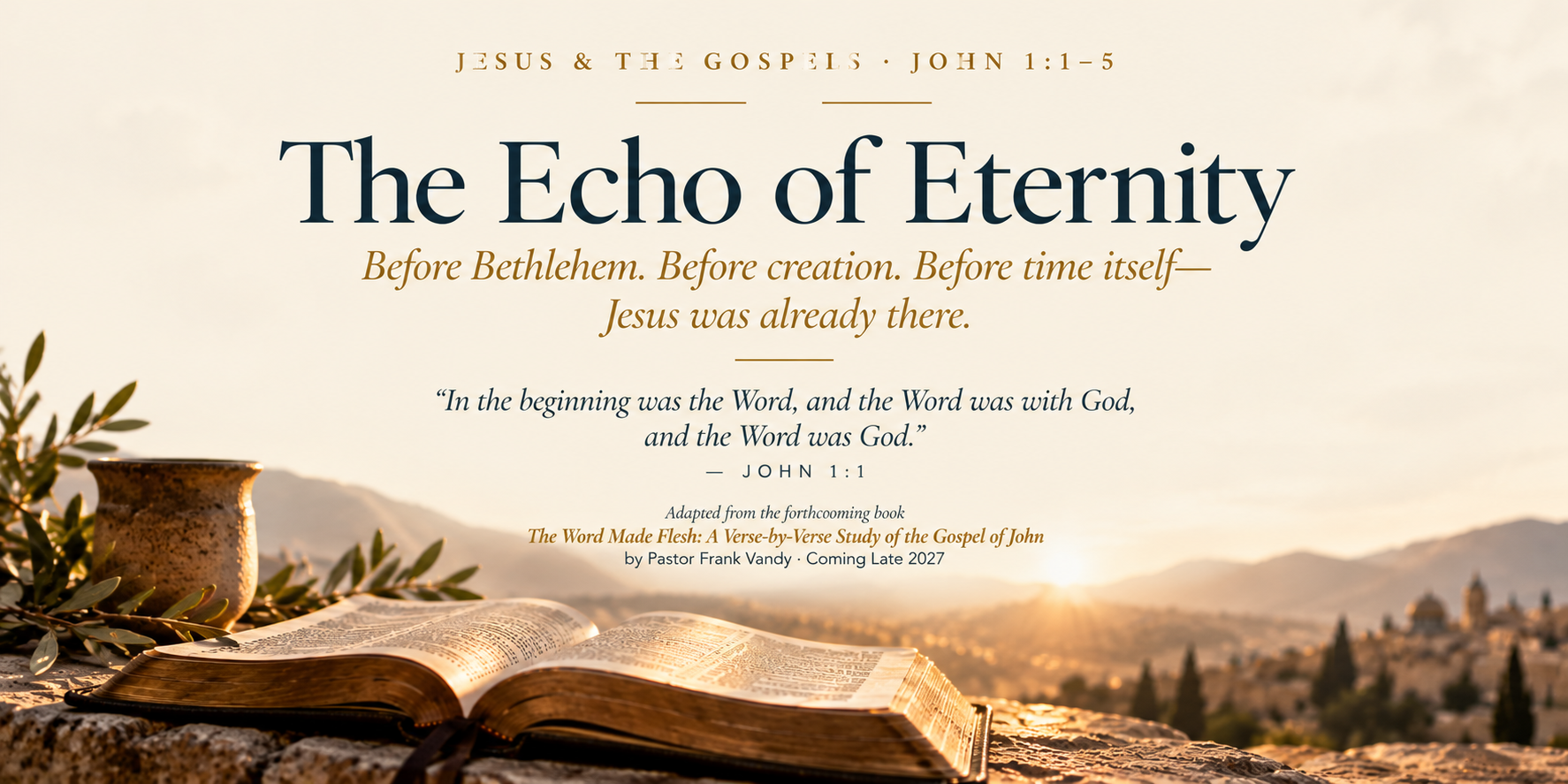
There are certain sentences in history that change everything the moment they are spoken.
“Let there be light.”
“It is finished.”
“He is not here; he has risen.”
The Gospel of John opens with one of those sentences.
In fact, it opens with what is arguably the most theologically dense, breathtakingly beautiful, and universe-altering paragraph ever written in any language.
Matthew begins with a genealogy of Jesus.
Mark begins with John the Baptist.
Luke begins with the miraculous births of John and Jesus.
But John?
John doesn’t begin in Bethlehem.
He doesn’t begin in Nazareth.
He doesn’t even begin with Abraham or even Adam.
John’s account of Jesus predates history altogether.
He steps outside of time and takes us back before the universe existed.
Before stars.
Before angels.
Before matter.
Before time itself.
John wants us to know something from the very first breath of his Gospel:
Jesus did not begin in Bethlehem.
Let’s read the first five verses.
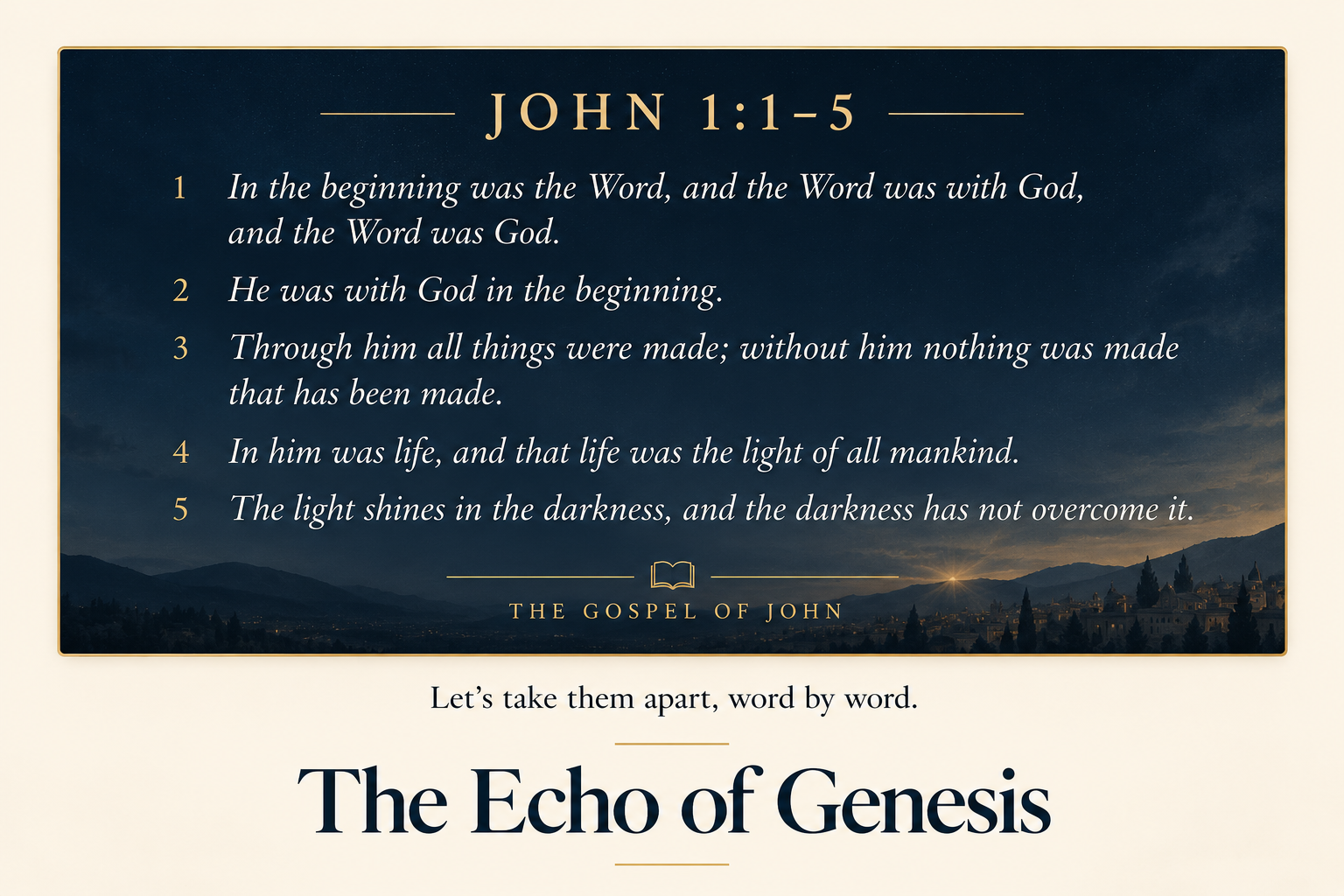
John begins with the exact same three words that open the Bible:
“In the beginning…”
That’s not an accident.
He’s deliberately echoing Genesis 1:1:
“In the beginning God created the heavens and the earth.”
Genesis begins with creation.
John begins before creation.
Genesis tells us what happened when time began.
John tells us who was already there when time began.
Then:
“In the beginning was the Word…”
The Greek word translated “was” (ēn) is important. John doesn’t say the Word came into existence in the beginning. He says the Word already was.
That means when the beginning began, Jesus was already there.
He didn’t come into existence at Bethlehem.
He didn’t come into existence when the angel appeared to Mary.
He didn’t come into existence when the universe was created.
He already was.
“…was the Word…”
This is where John does something absolutely brilliant. He introduces a concept that would have captivated both his Jewish and his Greek readers simultaneously.
The Greek term translated as “Word” is Logos.
TO THE GREEK WORLD
To the Greek philosophers of the first century, the Logos was the ultimate, organizing principle of the universe. They looked at the stars, the seasons, the laws of mathematics, and the order of nature, and they concluded that there must be some rational, divine force holding it all together. They called that force the Logos.
But to the Greeks, the Logos was an impersonal force.
It was an idea.
It was an equation.
It wasn’t someone you could know.
TO THE JEWISH WORLD
To the Jewish mind, the “Word of God” (Dabar) was something entirely different. The Word of God was the active, creative, dynamic power of God in action.
When God spoke in Genesis 1, His Word created galaxies.
When God sent His Word to the prophets, it shattered empires.
“By the word of the LORD the heavens were made.”
— Psalm 33:6
So John takes this massive, loaded word—Logos—and drops it right into the very first verse.
TO THE GREEKS
That ultimate, rational force holding the universe together that you have been searching for?
It’s not an equation.
It’s a Person and I knew Him.
TO THE JEWS
The creative power of God that spoke the universe into existence?
It didn’t just stay in heaven.
He took on flesh and I ate dinner with Him.
The Trinity in Eleven Words
“…and the Word was with God, and the Word was God.”
This is the hinge point of all Christian theology. In a single sentence, John establishes the doctrine of the Trinity.
First, he says:
“the Word was with God.”
The Greek preposition here is pros, which implies intimacy, face-to-face relationship, and distinction. The Word and God the Father are distinct persons. They are in a relationship. They are “with” each other.
But then, in the very next breath, John says:
“and the Word was God.”
He doesn’t say the Word was a god.
He doesn’t say the Word was like God.
He says the Word was God.
They share the exact same divine essence.
Distinction of persons. Unity of essence.
Both in the same sentence.
This is why we cannot accept the idea that Jesus was just a good moral teacher, or a prophet, or an enlightened man. John strips those options away in the very first verse.
The man who bled on the cross is the exact same being who existed in eternal, face-to-face fellowship with the Father before the universe was formed.
The Creator, Not the Created
“He was with God in the beginning. Through him all things were made; without him nothing was made that has been made.”
-John 1:2–3
John repeats himself in verse 2 for emphasis:
“He was with God in the beginning.”
Why?
Because he is about to make the most staggering claim about Jesus yet.
If Jesus is the Word, and the Word is God, then what did the Word do?
He created everything.
Notice the absolute, comprehensive language John uses:
“Through him all things were made; without him nothing was made that has been made.”
There is no exception clause here.
If it exists, Jesus made it.
The rings of Saturn.
The human eye.
The laws of physics.
The angels in heaven.
The wood of the cross He would one day be nailed to.
The empty tomb He would one day walk out of.
He made it all.
This completely destroys the ancient heresy (which still exists today in various forms) that Jesus was a created being—that He was the first and greatest creation of God the Father.
John says no.
If Jesus created all things that have been made, He cannot be part of the created order.
He is the Creator.
“For in him all things were created: things in heaven and on earth, visible and invisible, whether thrones or powers or rulers or authorities; all things have been created through him and for him.”
— Colossians 1:16
The Source of Life
“In him was life…” — John 1:4
As John moves from creation to the nature of Jesus Himself, he introduces the first of two massive themes that will run through the entire Gospel:
Life and Light.
“In him was life.”
The Greek word here is zoe. In the New Testament, zoe almost always refers to spiritual, eternal, uncreated life. It is the life of God Himself.
John is telling us that Jesus doesn’t just have life.
He doesn’t just give life.
He is life.
Think about the difference.
If I have a glass of water, I can give you a drink. But if I run out of water, I have nothing left to give.
Jesus is not a glass of water. He is the spring.
He is the uncreated, inexhaustible source of life itself.
This is why, later in this Gospel, Jesus will make those staggering “I AM” statements:
“I am the bread of life.” — John 6:35
“I am the resurrection and the life.” — John 11:25
“I am the way and the truth and the life.” — John 14:6
If you are spiritually dead, you cannot fix yourself by trying harder, being more moral, or going to church more often.
Dead things cannot generate life.
The only way a dead thing lives is if it is connected to the Source of Life.
The Light of Mankind
“…and that life was the light of all mankind. The light shines in the darkness, and the darkness has not overcome it.” — John 1:4–5
Here is the second massive theme:
Light.
In the biblical worldview, darkness is not just the absence of light. Darkness represents ignorance, sin, rebellion, and death.
When Adam and Eve rebelled in Genesis 3, a profound spiritual darkness fell over the human race.
But John says that the life of Jesus is the light of all mankind.
When Jesus steps into human history, He doesn’t just bring a new set of rules.
He brings illumination.
He shows us who God actually is, and He shows us who we actually are.
Then John gives us one of the most triumphant promises in the entire Bible:
“The light shines in the darkness, and the darkness has not overcome it.”
The Greek verb translated “overcome” (katalambano) is fascinating. It can mean to “understand” or “comprehend”—the darkness didn’t understand the light.
But it primarily means to “seize,” “overpower,” or “extinguish.”
Think about the darkest moments in the Gospel story.
Think about Judas slipping out into the night to betray Him.
Think about the religious leaders plotting His murder.
Think about the sky turning black at noon while He hung on the cross.
Think about the sealed tomb.
The darkness tried with everything it had to extinguish the Light.
It threw the full weight of human sin, demonic rage, and physical death at Jesus of Nazareth.
And it failed.
The darkness has not overcome it.
The tomb is empty.
The Light is still shining.
The Pastoral Reality
When you read these five verses, it is easy to get lost in the soaring, cosmic theology.
But I want to bring this down to the ground.
I want to bring this into the room where you are sitting right now.
Why does it matter that the Word was in the beginning?
Why does it matter that He created all things?
Why does it matter that He is the uncreated source of life and light?
It matters because of what He did next.
The God who spoke the galaxies into existence didn’t stay in the heavens.
The God who holds the universe together didn’t remain a distant, impersonal force.
He stepped into the mess.
He stepped into the darkness.
He took on flesh.
He allowed the hands He created to nail Him to the wood He spoke into existence.
He did it because He loved us, and He did it to bring us back to the Father.
If you are sitting in darkness today—whether it is the darkness of grief, the darkness of addiction, the darkness of fear, or the darkness of a broken past—hear the promise of John 1:5.
“The light shines in the darkness.”
And your darkness cannot overcome it.
He Knew — and He Created Us Anyway
When John tells us that the Word was in the beginning, that the Word was with God, and that the Word was God, he is not simply making a statement about eternity.
He is making a statement about omniscience.
If Jesus is eternal—if He has always existed, outside of time, before the first moment of creation—then He has always known everything.
There was never a moment when God the Father, God the Son, and God the Holy Spirit were surprised.
There was never a divine council meeting where someone raised a hand and said:
“I didn’t see that coming.”
Before God said, “Let there be light,” He already knew about the Garden of Eden.
He already knew about the serpent.
He already knew about the fruit.
He already knew about the moment Adam and Eve would reach out their hands and take the one thing He had asked them not to take.
He already knew about the shame, the hiding, the blame-shifting, and the broken fellowship that would follow.
He already knew about Cain and Abel.
He already knew about the flood.
He already knew about the Tower of Babel, the slavery in Egypt, the golden calf, the divided kingdom, and the exile.
He already knew about every war, every genocide, every act of cruelty one human being would ever commit against another.
He already knew about you.
He knew every sin you would ever commit.
Every thought you would ever be ashamed of.
Every moment you would turn your back on Him.
Every time you would choose yourself over Him.
He knew all of it.
And He created us anyway.
And He created you anyway.
Let that sit for a moment.
Don’t rush past it.
The eternal, omniscient Son of God—the one through whom all things were made, in whom was life, who was the light of all mankind—looked down the full corridor of human history before He spoke a single atom into existence.
He saw the cross.
He saw Calvary.
He saw the nails, the thorns, the spear, and the darkness at noon.
He saw the full, unbearable weight of every human sin that He would one day carry in His own body.
He saw the price tag.
And He said yes.
He said yes.
He said, “Not my will be done, but yours.”
The Apostle Peter, writing under the inspiration of the Holy Spirit, gives us a glimpse behind the curtain of eternity in his first letter. He describes Jesus as:
“a lamb without blemish or defect, who was chosen before the creation of the world, but was revealed in these last times for your sake.” — 1 Peter 1:19–20
Chosen before the creation of the world.
The cross was not Plan B.
It was not a divine emergency response to an unexpected catastrophe.
The sacrifice of the Lamb of God was planned, purposed, and agreed upon in the eternal counsels of the Trinity before the first star was ever lit.
The theologians call this the Covenant of Redemption—the eternal agreement within the Godhead in which the Father would send the Son, the Son would willingly go, and the Holy Spirit would apply the work of redemption to every soul who would believe.
This covenant was not struck after the Fall.
It was struck before the foundation of the world.
The Lamb Slain From the Beginning
Revelation 13:8 speaks of Jesus as “the Lamb who was slain from the creation of the world.”
In the eternal perspective of God, the sacrifice was as good as done before the first human breath was ever drawn.
Think about what this means for the opening verses of John’s Gospel.
When John tells us that “through him all things were made, and without him nothing was made that has been made,” he is telling us that the hands that shaped the first man from the dust of the ground were the same hands that would one day be stretched out on a Roman cross.
The voice that said “Let there be light” was the same voice that would one day cry out:
“My God, my God, why have you forsaken me?”
He made us knowing what it would cost Him.
He made us knowing that the wood He spoke into existence would one day become the instrument of His own execution.
He made us knowing that the iron He placed in the earth would one day be hammered into nails and driven through His wrists.
He made us knowing that the human capacity for cruelty—the freedom He gave us to choose—would be turned against Him in the most brutal way imaginable.
He knew.
He saw it all.
He counted the cost in full.
And He still said, “Let there be light.”
There is no greater love in the universe than this.
Not the love of a parent who would die for a child they already love.
Not the love of a soldier who would die for a country he has already pledged his life to.
This is the love of a Creator who looked at people who did not yet exist, who would not deserve His love, who would reject Him, who would betray Him, who would nail Him to a cross—and chose to make them anyway because He wanted them to have the chance to come home.
The Apostle Paul, writing to the church in Rome, captures this truth in a sentence that should stop every one of us cold:
“But God demonstrates his own love for us in this: while we were still sinners, Christ died for us.” — Romans 5:8
While We Were Still Sinners
While we were still sinners.
Not after we cleaned ourselves up.
Not after we proved our worth.
While we were still in the full expression of the rebellion He had foreseen before He ever said our names.
This is the God of John 1:1–5.
This is the God who was in the beginning.
This is the God who is the Word.
This is the God through whom all things were made.
He is not a distant, impersonal force.
He is not a cosmic clockmaker who wound up the universe and walked away.
He is a God who looked at the full cost of loving you—every heartbreak, every betrayal, every nail—and decided that you were worth it.
Before you ever existed, you were worth it to Him.
That is where the Gospel of John begins.

KEEP STUDYING
Continue Studying Jesus & the Gospels
There’s always more to learn about Jesus and the gospels. Explore more teachings from the gospels and deepen your walk with Jesus.