There are moments in Scripture when the timing of something takes our breath away.
Luke 22 gives us one of those moments.
Jesus is hours away from the cross.
He has gathered His disciples in an upper room.
He has broken the bread.
He has poured the cup.
He has told them that His body will be given for them and His blood poured out for them.
He has announced that one of the men sitting at the table will betray Him.
And then Luke tells us:
“A dispute also arose among them as to which of them was considered to be greatest.” — Luke 22:24
Think about that.
The shadow of the cross is falling over the room.
And the disciples are arguing about rank.
But to understand how extraordinary this moment really is, we first need to understand something else.
We need to understand who is sitting at the table.
Because the argument of the disciples becomes devastating when we understand who is watching it.
Who Is in the Room?
Many people look at the Last Supper and see Jesus, a great teacher having a final meal with His followers.
A rabbi saying goodbye.
A beautiful, tragic moment of human friendship before a terrible execution.
They see a man.
But that is not the complete picture of who Jesus is.
The disciples are arguing about who is the greatest among them...
while the greatest of all is sitting at the table.
He Is the Eternal Word
John opens his Gospel with these words:
“In the beginning was the Word, and the Word was with God, and the Word was God. He was with God in the beginning. Through him all things were made; without him nothing was made that has been made.” — John 1:1–3
Notice what John does not say.
He doesn't say, “In the beginning, God created the Word.”
He says:
“In the beginning was the Word.”
Before the beginning began, He already existed.
He did not come into being.
He simply was.
John deliberately echoes the opening words of Genesis.
Genesis says:
“In the beginning God created...”
John says:
“In the beginning was the Word...”
Genesis begins with creation.
John takes us to a place before creation.
Then John tells us that the One through whom creation came into existence eventually stepped into His own creation.
The hands passing bread around the table were the hands through which humanity had been made.
The voice speaking to the disciples was the voice that had once said, “Let there be light.”
That is who is in the room.
He Is the Sustainer of All Things
Paul takes us even further:
“For in him all things were created... all things have been created through him and for him. He is before all things, and in him all things hold together.” — Colossians 1:16–17
Jesus is not simply the Creator of the past.
He is the Sustainer of the present.
“In him all things hold together.”
The universe does not simply owe its beginning to Him.
It owes its continued existence to Him.
The man sitting at that table is not simply a great teacher.
He is the reason the table exists.
He is the reason the room exists.
He is the reason every disciple sitting around it exists.
He Is the Glorified King
Now move from the beginning of the Bible to its end.
Years later, John—the same John who sat with Jesus in that Upper Room—would encounter the risen Christ on Patmos.
This time John didn't lean against His chest.
He fell at His feet as though dead. (Revelation 1:17)
John saw eyes like blazing fire.
A voice like rushing waters.
A face shining like the sun in all its brilliance.
And Jesus declared:
“I am the First and the Last. I am the Living One; I was dead, and now look, I am alive for ever and ever!” — Revelation 1:17–18
This is the Jesus sitting at the table.
The Eternal Word.
The Creator.
The Sustainer.
The Living One.
The King.
And that Jesus is about to watch twelve men argue about which one of them is the greatest.
The Argument at the Table
The timing almost makes the disciples' argument difficult to comprehend.
Earlier that evening, Jesus had done something extraordinary.
He got up from the meal.
Removed His outer garment.
Wrapped a towel around His waist.
Poured water into a basin.
And knelt.
In the ancient world, washing feet was the work of the lowest servant in the household.
Yet no one had volunteered.
Peter didn't.
John didn't.
Matthew didn't.
So Jesus did.
The Creator of the universe got on His knees.
One by one, He washed their feet.
Peter's feet—the man who would soon deny Him.
Thomas's feet—the man who would doubt Him.
And Judas's feet—the man who had already agreed to betray Him.
He knew exactly what each of them would do.
And He washed their feet anyway.
Then Jesus returned to the table.
He broke the bread.
He poured the cup.
He announced the new covenant in His blood.
He told them that one of them would betray Him.
And then...
they began arguing about who was greatest.
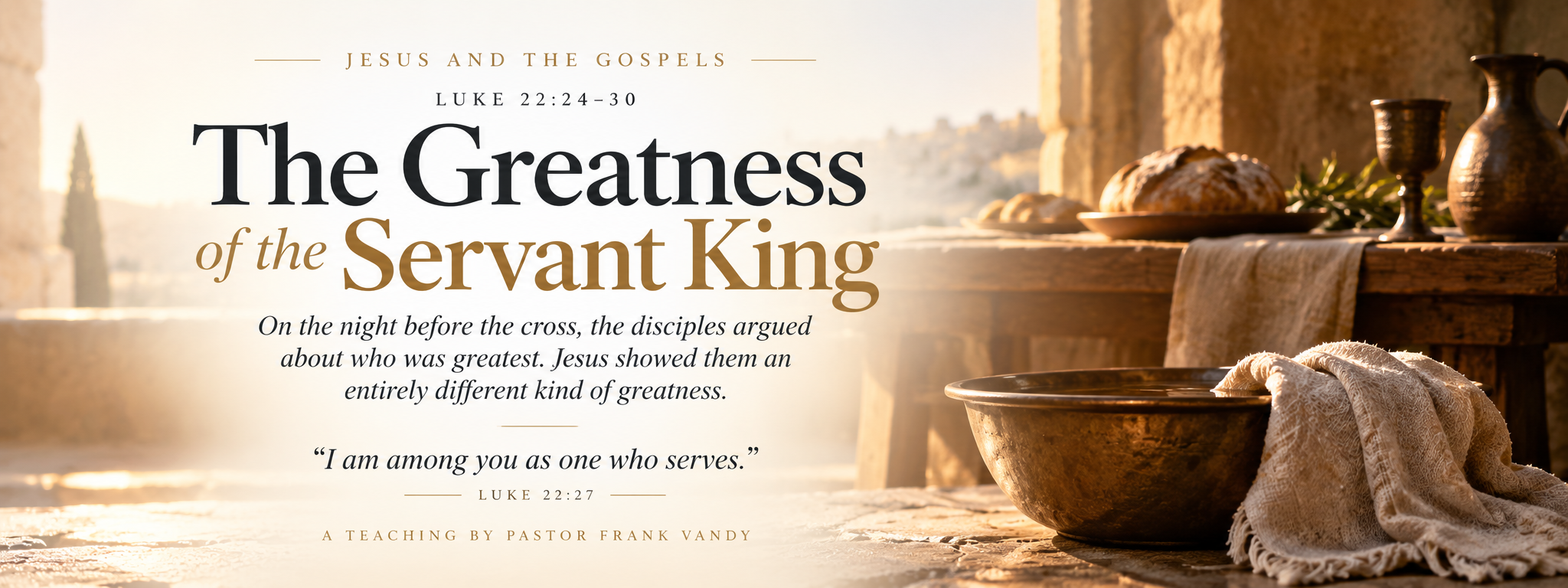
The towel was still damp.
The basin of dirty water was still nearby.
They had just watched the greatest One in the room take the lowest position in the room.
And somehow...
they still missed it.
A Different Kind of Greatness
Jesus could have been furious.
He could have rebuked them harshly.
He could have pointed toward the cross and said, “How can you possibly be talking about this now?”
Instead...
He teaches them.
Patiently.
Deliberately.
With the cross only hours away, Jesus explains one more time what greatness looks like in His kingdom.
He says:
“The kings of the Gentiles lord it over them; and those who exercise authority over them call themselves Benefactors.” (Luke 22:25)
Jesus begins with the world's model.
In the world's system, greatness moves upward.
Get the position.
Get the title.
Get the recognition.
Get enough authority that other people serve you.
Then Jesus turns the entire system upside down:
“But you are not to be like that. Instead, the greatest among you should be like the youngest, and the one who rules like the one who serves.” — Luke 22:26
Jesus isn't saying leadership is wrong.
He is redefining leadership.
In the kingdom of God, authority and humility are not opposites.
They belong together.
Then Jesus makes the lesson impossible to miss:
“For who is greater, the one who is at the table or the one who serves? Is it not the one who is at the table? But I am among you as one who serves.” — Luke 22:27
Read that last sentence again.
“I am among you as one who serves.”
The Alpha and Omega.
The Creator of the universe.
The One in whom all things hold together.
The One with eyes like fire.
The One who holds the keys of death and Hades.
He is among them as one who serves.
The world's greatest leaders build monuments to themselves.
The King of the universe picked up a towel.
The Grace at the Table
But then something happens that may be even more surprising.
After their pride...
after their argument...
after completely missing the lesson Jesus had just demonstrated...
Jesus says:
“You are those who have stood by me in my trials. And I confer on you a kingdom, just as my Father conferred one on me...” — Luke 22:28–29
What grace.
Jesus does not define them by their worst moment.
He doesn't say: You are the men who argued about greatness while I was preparing to die.
He doesn't say: You are the men who still don't understand after three years with Me.
He doesn't say: You are the men who will soon abandon Me.
Instead:
“You are those who have stood by me in my trials.”
He sees their imperfect faithfulness.
And He also sees something they cannot yet see.
He sees what His grace will make them.
These flawed, confused, prideful disciples will become leaders in His kingdom.
But notice the order.
The thrones come after the towel.
The kingdom comes after the service.
The authority comes after the humility.
Jesus isn't withholding the kingdom from them.
He is preparing them for it.
The path to the throne goes through the basin.
The Towel Test
It is easy to judge the disciples.
How could they possibly argue about greatness while the towel was still damp?
But their argument never really ended.
We still keep score.
We still notice when someone else gets the credit.
We still feel the sting when our work isn't recognized.
We still compare.
We still want the better seat.
And the towel test shows up in remarkably ordinary places.
It happens in marriages when both people silently keep track of who gives the other more.
It happens at work when recognition matters more than service.
It happens in churches when platform becomes confused with significance.
Jesus offers another way.
He goes first.
He serves before He is served.
He loves before that love is returned.
He washes the feet of people who will fail Him.
Even the feet of someone who will betray Him.
The question isn't simply:
Do I believe in servant leadership?
The question is:
Where is the towel in my life?
Who can I serve when no one will notice?
Who can I encourage without receiving anything in return?
What job have I quietly decided is beneath me?
Who am I waiting to serve me before I serve them?
The Cross Was the Ultimate Act of Service
The basin was not the end of the story.
It was a picture of what was coming.
A few hours later, Jesus left the Upper Room.
He went to Gethsemane.
He was arrested.
Beaten.
Mocked.
And crucified.
Paul describes it this way:
“Christ Jesus... made himself nothing by taking the very nature of a servant... he humbled himself by becoming obedient to death—even death on a cross!” — Philippians 2:5–8
The foot washing was the picture.
The cross was the reality.
He did not simply wash the dirt from their feet.
He came to wash the sin from our souls.
He did not simply kneel in a private room.
He hung on a public cross.
He didn't simply serve the twelve men gathered around a table.
He gave Himself for the world.
That is the Servant King.
And that changes the way we understand greatness.
Pick Up the Towel
The greatest person who ever walked the earth knelt before men who would fail Him.
He washed the feet of Judas.
He washed the feet of Peter.
He washed the feet of men who would fall asleep while He prayed in agony.
He knew exactly who they were.
He knew exactly what they were about to do.
And He washed their feet anyway.
So perhaps the question Luke 22 leaves us with is much simpler than we expect:
If the Creator of the universe can pick up a towel, what is beneath you?
Who have you decided doesn't deserve your service?
Who are you waiting to go first?
Where are you keeping score?
Where are you fighting for the better seat when Jesus is pointing toward the basin?
Greatness in the kingdom of God is not found in the seat you occupy.
It is found in the towel you carry.